Today’s audience: Practitioners in private practice.
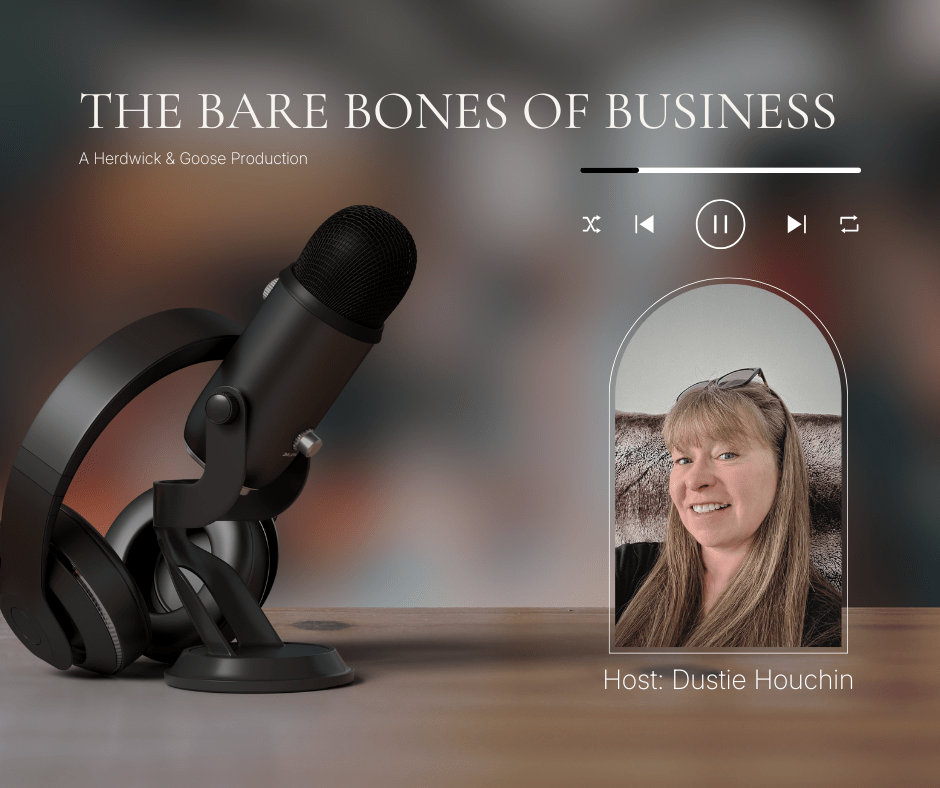
Hello, and welcome. I’m Dustie, speaking on behalf of Herdwick & Goose. This is a short audio note for our practitioner community—an opportunity to share useful thinking, practical perspective, and conversations that support the work you do.
Last week, I discussed why it is prudent to have a clear vision in place from the start of your business. Today, I want to talk about the basic building blocks of any business journey, so you are not left trying to work everything out in the dark.
I know some of you have recently graduated and may be wondering, quite frantically, how to take the next step. If you already have a practice, looking back at what you did or did not do at the start may help you see where different choices could put you back on track.
Let’s keep this super simple.
A business is made up of several different components:
- Finance: No business can run without money, so keeping your finances in check is essential. It tells you how much you need to set up, keep going and stay afloat. Put simply, it’s money in, money out.
- Operations Management: In a clinical setting this can include items such as scheduling, continuous improvement of the business, making effective use of your space, inventory control, training etc.
- Strategy: This is a big word for knowing where you’re going and why. It can be tagged onto numerous other business elements, such as Marketing Strategy, which just means to know who you’re marketing to, why you’re marketing to them and being clear about the end goal.
- Leadership: Steering the business on its journey. Communicating with the people who matter. Keeping everything on track and knowing how to change direction when needed.
- Brand management and marketing: I discuss these topics in more depth below.
- Customer support: Self-explanatory.
- Sales: The word that sends shivers up most practitioners’ spines.
- Legal and compliance: Working in a way that aligns with regulatory requirements.
So, you’re fresh out of college or university.
You need somewhere to run your business. That could be a room in someone else’s practice, or it could mean buying or renting an office of your own. The cost of the space you choose depends on several factors. Have you got funds saved up? Do you have another form of income? Is your family behind you, giving you a chance to grow? The answer to each of these questions leads to a different outcome.
Once you have a room, you need to furnish it. The key here is to keep business expenses away from personal expenses, so you can easily list the costs of your business at the end of the year. This is vital for your accounts and will ensure you don’t foot the bill for items that could go through the business—thus saving you tax.
Once you know where your business is going to open and you have the furnishings on order, it’s time to decide your hours, and to start attracting customers.
Branding in clear language
Many people see branding as colour palettes and logos. It’s so much more than that.
A business is a location that houses a brand.
A brand is the blood line of the business because it helps an audience to understand its values, vision, purpose and positioning (where you fit in the market). Think of it as the personality of your business, as seen by your customers.
It is the clothes you wear, the way you speak and how your practice looks to the outside world.
Once you have a clear brand in place, and your customers understand who you are, what you do, and how and why you do it, a relationship starts to form. Just like any friendship, if someone resonates with you, they are naturally attracted to learn more. They are curious about your plans, what you do and where you work. And they want to tell their friends that they’ve found you.
The key at this stage is to ensure that you remain consistent. Like any friendship, people like to know that you are trustworthy, stand by your values and do as you say you will do. If you say you will send them a weekly update, for example, do it. If you say you will drop in, do it. It’s that simple. This builds trust and trust builds loyalty.
And this in the simplest of terms, is marketing.
Marketing has changed a lot since I first studied it. AI will soon be integrated into almost everything we do, which means commercial marketing is increasingly about analytics, metrics and automation. But that is far more complicated than you need right now. For now, you just need to know that marketing is about understanding your people, aligning your offer with their needs, and communicating with them regularly. Let me explain.
Many marketers would say that it’s all about pain points and focusing on customers’ needs, but I have a different strategy. I believe that the most infectious energy comes from people who love what they do. They shine in a way that no one else can. People are drawn to that.
The right people are drawn to you because they are curious. And when that curiosity aligns with a question they have been asking for a long time, magic happens.
Example: A customer is scrolling through Facebook. They stumble across a reel you’ve created. They see your face, your smile, your softness and, subconsciously, you make them feel safe. You talk about your work with passion and energy in a way that says, she knows what she’s doing and she clearly loves it. That draws them in. They watch more.
Realising that you treat a condition they suffer with, they become intrigued. They check out your page, your website and your location. You’re not as close as they would like, but they feel compelled to book an appointment all the same, because everything about you says you’re the right person.
They book an appointment, attend as planned, and you do a great job. You are everything they expected. They feel safe, heard and respected. And you help them with their problem, giving them hope.
They leave your office feeling fabulous, shout about you to their friends, and write a review on Facebook for everyone to read. Their friends are impressed, so they too look you up. Book appointments and concur that you’re every bit as wonderful as she said.
This is the power of alignment.
You didn’t push. You didn’t sell. You just talked about what you do from the heart and people followed. This is the perfect type of marketing because people came to you without any sense of pressure.
In all the years I’ve worked with osteopaths, physiotherapists and other healthcare (and veterinary) professionals, I’ve never found a person who loves selling. In fact, most see it as a dirty word.
I have a very different view of sales, but that’s not for today. Put simply, as far as I’m concerned, selling done well should be about serving and making sure the people you can help know you exist.
Today, we’ve covered the very basics of a new business: the bare bones. This is just an introduction to words and concepts that may feel alien, because my aim is to make all of this feel easier.
Take-home for today.
No matter where you are on your journey, understanding the various facets of business is helpful. It helps us to map out the future in a clean and linear fashion, instead of guessing and hoping.
If this post resonated with you and you want to learn more, sign up today to receive invitations to private workshops and free masterclasses. I’ve been where you are. Let me help make it simple.
Dustie
Dustie Houchin is the Executive Director of Herdwick & Goose Limited. She has been in clinical practice since 1998, and taught practice development for more than 14 years.
 HERDWICK & GOOSE
You must be logged in to post a comment.